
















A low-engagement caption usually has one of four problems: a weak first line, no clear ask, a length that is too short, or a voice that sounds like everyone else's. An AI tool can fix the first three well, and the fourth only with your brand context. It cannot fix a post nobody wanted. Diagnose first, then judge any tool by whether it fixes your specific problem.
TLDR: Compare each weak caption to your own median, not to a benchmark. Then pick the tool that scores or rewrites against your own results and lets a person approve the output. In Mydrop's data, captions under 80 characters ran 9% below the account's typical post, an easy fix.
Mydrop data, September 2026: across accounts connected to Mydrop, which manages 55,000+ posts, captions under 80 characters ran 9% below their account's typical post. From 80 characters up, length made no measurable difference: every bucket from 80 to 600+ characters sat within 3% of the median. Method and full tables in the Mydrop social media benchmarks.
Diagnose the caption before you buy anything
Pull the ten worst captions from the last 60 days. Compare each post to your own median engagement, and ignore industry averages. For scale, Mydrop's data puts the median Instagram engagement rate at 3.1%, with the middle half of posts between 1.1% and 6.7%. A 2% post is normal. A 0.5% post is a miss.
| Symptom | Likely cause | Fix |
|---|---|---|
| Few people expand or read on | Weak first line | Rewrite the first 8 words, three versions |
| Reach fine, no comments or saves | No ask | Add one specific action |
| Caption is a single short line | Under 80 characters | Write two full sentences |
| Reads like every other brand | Generic voice | Give the tool real examples of your posts |
| Everything underperforms equally | Offer or image, not copy | Fix that first |
The last row matters. If the image is flat or the offer is dull, no caption tool will help.
What the tool has to do, in order
- Rewrite against your voice, not a default. Feed it five posts that worked. If it cannot take brand context, you will get polished, generic captions.
- Show you variants, not one answer, so you choose with your own judgment.
- Let you measure the result. A caption fix is a hypothesis. You need to see whether the new version beat the old median.
- Put a person between draft and publish.
Skip tools that promise a "virality score". Nothing predicts engagement reliably from the text alone. A better test is whether the tool makes it easy to compare before and after on your own posts.
Run a fair test on 10 posts
Take five weak captions and rewrite them with the tool. Publish the new versions at the usual time. Keep format and hour the same, otherwise you are testing the wrong thing. After a week, compare each new post to your median.
If three of five move up, the tool is earning its place. If none does, the cause is not the caption.
Compare each AI rewrite to the account median in one place
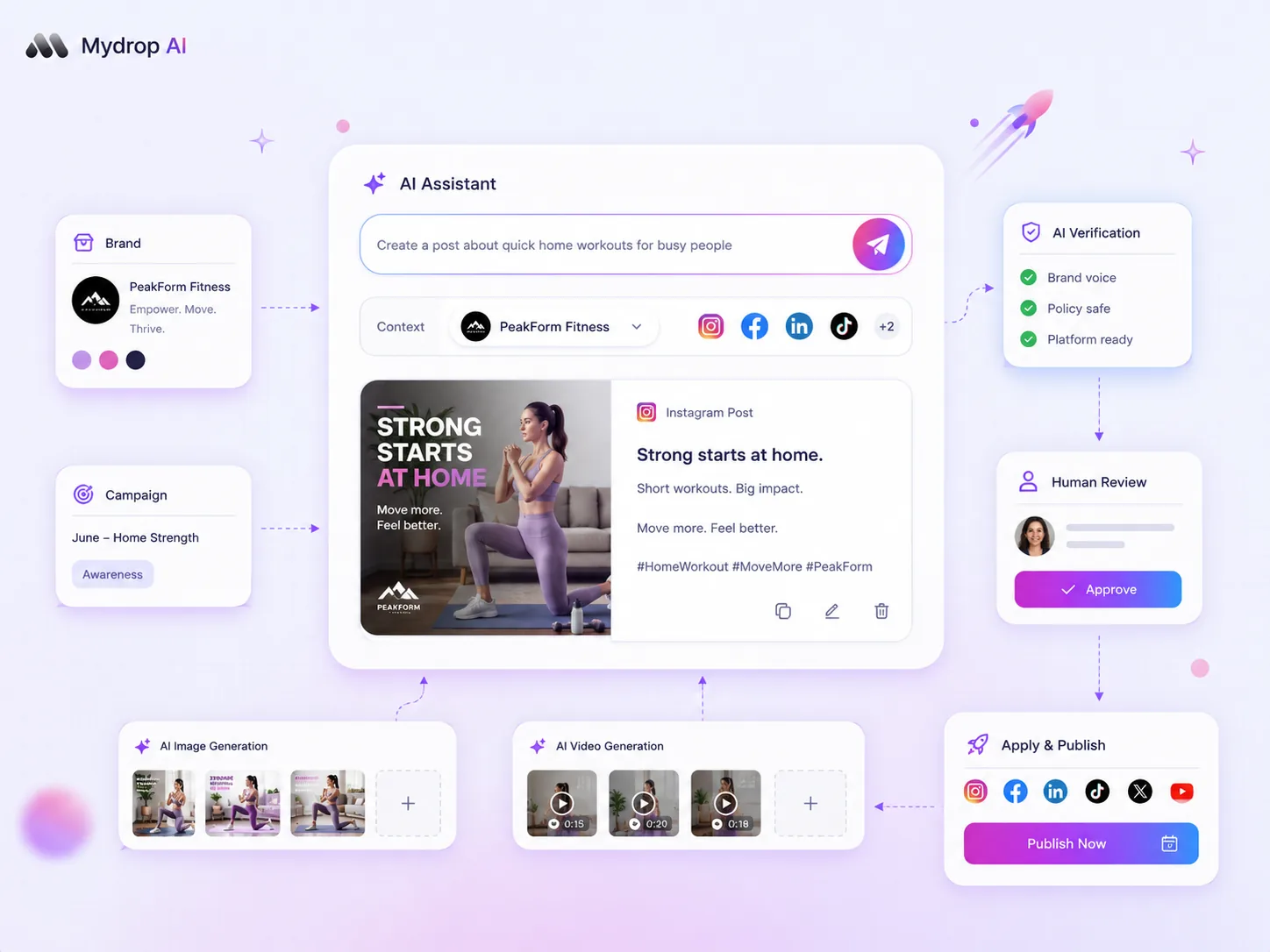
Mydrop's AI captions generate variants for a post, and the performance view shows each post against that account's own median, so the before-and-after check is in the same tool. Drafts can go through approvals before publishing. If your problem is mostly an off-voice tone, read why AI captions feel off-brand.
Change one thing per rewrite
When you rewrite a weak caption, change the first line or the ask, not both. If you change everything, you will not learn what worked, and the next rewrite starts from zero. Keep a simple note of the old caption, the new one, and the change you made, so a pattern shows up after ten posts.
Do not chase length
Longer is not better. From 80 characters up, every length bucket in our data sat within 3% of the median. Our guide to caption limits by platform covers where hard caps apply.
Rewrite five captions this week
Choose your five lowest posts, apply the symptom table, and republish the rewrites. Keep notes on what changed. When you want to test at scale across accounts, start free with Mydrop.



 Google review
 Trustpilot review
 Product Hunt comment